
← Experience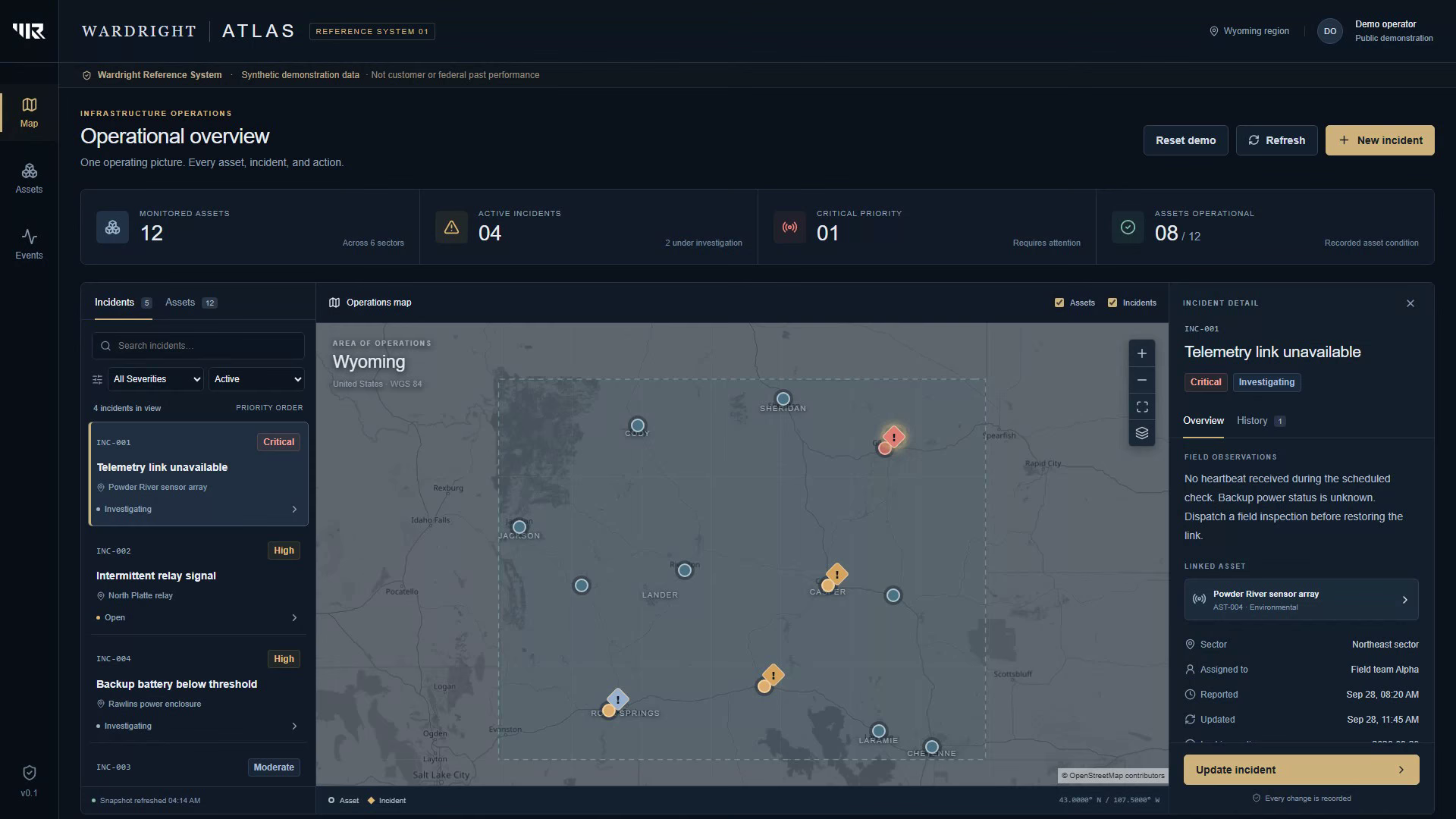
WARDRIGHT REFERENCE SYSTEM
Atlas
Geospatial Operations & Data Reference System
A browser-based geospatial operations reference system integrating interactive geographic visualization, synthetic operational records, and PostgreSQL/PostGIS-backed workflows.
Technical stack at a glance
- Frontend
- Next.js · React · TypeScript
- Backend
- Node.js · Server APIs
- Database
- PostgreSQL 17 · PostGIS 3.6
- Geospatial
- Spatial SQL · Interactive mapping
- Infrastructure
- Railway · GitHub · Cloudflare
- Verification
- Migration checks · HTTP 200 health endpoint
Engineering behind Atlas
System architecture
- Full-stack web architecture — Next.js browser-based geospatial interface, server-side APIs, and PostgreSQL/PostGIS operational data.
- Distributed service separation — Independently deployed web application, PostgreSQL/PostGIS database, and controlled migration service; background maintenance was included in the deployment plan.
- Geospatial operations architecture — Spatial database records integrated with interactive geographic visualization and operational inspection.
- Temporary workspace isolation — Anonymous workspaces with synthetic operational data; exact isolation and expiration enforcement require final verification.
- Stateful demonstration workflows — Server-backed workspace, incident, event, and reset operations.
- Spatial data processing — PostgreSQL/PostGIS geographic types, functions, and database-side geospatial operations.
- Deterministic database initialization — Explicit schema migrations, required migration-version checks, and production startup validation.
- Operational resilience — Database-backed state, controlled migrations, restricted runtime privileges, and readiness checks.
Application development
- TypeScript and Node.js — Application logic, APIs, database access, and operational scripts.
- Next.js and React — Geospatial interface, responsive layout, navigation, operational panels, and interactive data presentation.
- Interactive geographic visualization — Map-centered presentation of synthetic assets and incidents.
- Asset and incident inspection — Interfaces for geographic records, operational metadata, and demonstration information.
- Workspace interactions — Create, update, inspect, and reset synthetic demonstration state.
- Operational dashboard development — Geographic workspace, metrics, contextual panels, and status-oriented information.
- Responsive interface design — Wardright identity, persistent navigation, structured panels, restrained status treatments, and mobile considerations.
- Application health validation — Production health endpoint with verified HTTP 200 following database configuration.
Data & integration
- PostgreSQL 17 / PostGIS 3.6 — Production relational database with spatial extension verified in the Railway deployment.
- Relational schema design — Migration-controlled assets, users, workspaces, incidents, events, and rate-limiting state.
- Geospatial database capabilities — PostGIS functions and geographic data support.
- Role-based database access — Separate migration-owner authority and restricted atlas_runtime identity.
- Least-privilege SQL grants — Explicit table and sequence permissions for workspace, incident, event, and rate-limit records.
- Controlled database functions — Reset and cleanup routines with explicit runtime execution grants.
- Migration integrity checks — Required versions checked against schema_migrations before readiness.
- Synthetic operational datasets — Database-backed demonstration records; 12 asset records confirmed during testing.
- Transactional database operations — Explicit BEGIN, COMMIT, and ROLLBACK support.
- Structured data exchange — PostgreSQL-backed APIs and JSON-oriented communication.
Deployment & operations
- Railway cloud infrastructure — Hosted web app, PostgreSQL/PostGIS, and separate migration service.
- Git and GitHub — Source control and Railway-connected deployment workflow.
- Controlled database migrations — Separate atlas-migrate service.
- Persistent PostgreSQL storage — Railway volume with database data subdirectory.
- Service-specific credentials — Restricted atlas_runtime web identity.
- Private service networking — Internal Railway application-to-database hostname.
- Production readiness validation — Verified connectivity, migrations, PostGIS, and HTTP 200 health response.
- Custom domain integration — atlas.wardright.com with Cloudflare DNS and Railway configuration.
- TLS configuration — Custom-domain certificate provisioning and successful browser access after initial validation.
- Database connection management — Bounded Node PostgreSQL pool, connection, idle, and statement timeouts.
- Runtime privilege enforcement — Startup checks designed to reject elevated runtime roles.
- Operational diagnostics — Railway SSH, PostgreSQL authentication and role testing, and direct health checks.
- Deployment troubleshooting and recovery — Volume initialization, migration, credentials, and certificate issues resolved.
- Evidence-driven deployment acceptance — Connectivity and HTTP 200 verified; broader security, backup, maintenance, and browser-workflow acceptance require separate evidence.