
← Experience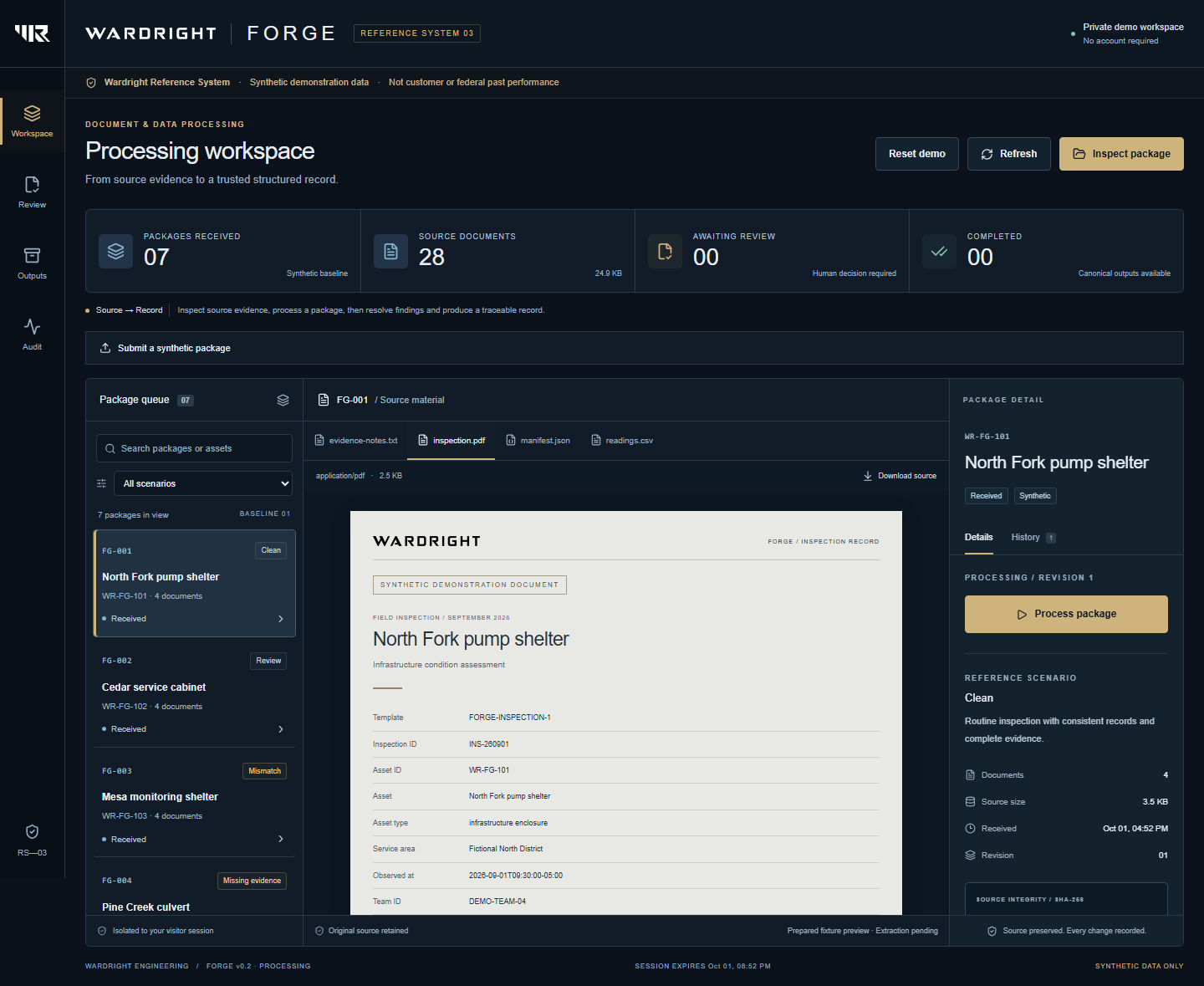
WARDRIGHT REFERENCE SYSTEM
Forge
Document Processing & Workflow Reference System
A full-stack document and data processing reference system demonstrating controlled intake, extraction, validation, human review, structured outputs, and traceable operations.
Technical stack at a glance
- Frontend
- Next.js · React · TypeScript
- Backend
- Node.js · Server APIs
- Database
- PostgreSQL 18 · SQL · RLS
- Processing
- Asynchronous workers · Job leasing
- Infrastructure
- Railway · GitHub
- Verification
- Chromium · Automated tests · SHA-256
Engineering behind Forge
System architecture
- Full-stack web architecture — Next.js browser interface, server APIs, and PostgreSQL workflows.
- Distributed service separation — Web app, worker, scheduled maintenance, and controlled migration job.
- Asynchronous job processing — Database-coordinated jobs, leases, retries, stale-worker detection, and recovery.
- Stateful workflow orchestration — Intake, classification, extraction, validation, review, approval, transformation, completion.
- Temporary workspace isolation — Anonymous four-hour workspaces with generation tracking and isolated package/document state.
- Human-in-the-loop controls — Review, correction, revalidation, and approval before finalized outputs.
- Deterministic processing and traceability — Structured outcomes, revisions, content hashes, and audit records.
- Resilience engineering — Idempotency, duplicate intake, lease enforcement, and worker interruption recovery.
Application development
- TypeScript and Node.js — Application, APIs, services, and scripts.
- Next.js and React — Responsive interface, document review, workflow interactions, and server functionality.
- Document intake and validation — Admission, file-size limits, media-type handling, hashing, and quotas.
- Document extraction and transformation — Source documents into structured findings and canonical artifacts.
- Review and correction interfaces — Conflict resolution, feedback, approvals, and versioned changes.
- Output generation — JSON, reports, and supported export formats.
- Responsive interaction design — Desktop/mobile, keyboard controls, navigation, and browser regression tests.
- Automated quality assurance — TypeScript, unit/parser tests, production builds, and Chromium functional tests.
Data & integration
- PostgreSQL 18 — Persistence for workspaces, packages, documents, jobs, revisions, audits, and artifacts.
- Relational schema design — Foreign keys, constraints, indexes, transactions, and migrations.
- Row-level security — Database-enforced workspace isolation.
- Role-based database access — Separate schema, web, worker, and maintenance identities.
- Security-definer functions — Controlled operations with explicit privileges and search paths.
- Data integrity verification — SHA-256 for sources, outputs, fixtures, and recovery comparisons.
- Synthetic baseline datasets — Seven packages with 28 source documents.
- Transactional consistency — Coordinated package, processing, output, and audit changes.
- Audit and revision tracking — Actions, events, corrections, approvals, and lineage.
- Structured data exchange — JSON, APIs, and downloadable artifacts.
- Backup and recovery engineering — Consistent snapshots, logical exports, isolated restoration, and verification of data, privileges, sequences, and policies.
Deployment & operations
- Railway cloud infrastructure — Separate app, worker, maintenance, migration, and PostgreSQL services.
- Git and GitHub — Private source, evidence, and revision-specific releases.
- Controlled deployment — Git-push automatic deployments disabled; explicit release approval.
- Persistent database storage — Database lifecycle separate from application deployment.
- Service-specific credentials — Least-privilege and administrative/runtime separation.
- Scheduled maintenance — Expiration and cleanup of temporary workspaces.
- Operational health monitoring — Readiness, worker availability, service health, and stale-worker detection.
- Failure recovery testing — Worker termination, lease expiry, reclamation, and stale-commit rejection.
- Concurrency and load validation — Independent web processes, concurrent requests, duplicate handling, and isolation checks.
- Dependency security management — Controlled updates, audits, and regression verification.
- Production data preservation — Workspace, revision, audit, and artifact integrity across redeployments.
- Disaster recovery planning — Verified isolated logical restore; durable off-service backup coverage pending a final decision.
- Evidence-driven acceptance — Deployment receipts, tests, integrity manifests, and explicit verification boundaries.